


 Free: The Future of a Radical Price by Chris Anderson
My rating: 3 of 5 stars
Interesting look at the history of Free in merchandising and its implementation in the information age. Take heed!
Filed under: Micro Book Reviews | 1 Comment »
Free: The Future of a Radical Price by Chris Anderson
My rating: 3 of 5 stars
Interesting look at the history of Free in merchandising and its implementation in the information age. Take heed!
Filed under: Micro Book Reviews | 1 Comment »
 The Long Walk: The True Story of a Trek to Freedom by Slavomir Rawicz
My rating: 4 of 5 stars
Amazing story of a small band of political prisoners who escape from a Russian gulag in Siberia and make their way to India. A tribute to the resilience of the human spirit.
Filed under: JCFness | 2 Comments »
 A Death of Honor is currently the #1 Kindle book in Free Science Fiction and has cracked the Top 100 of overall Free Kindle Books. My thanks to everyone who has downloaded a copy and made this possible so far.
Honor will continue to be free through Saturday the 11th. If you haven’t gotten your copy yet, click yourself over and snag one now!
Filed under: A Death of Honor | Tagged: Free | 2 Comments »
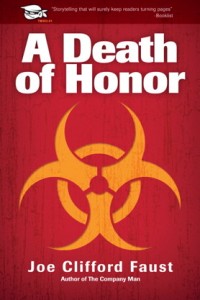 So you’ve been wanting to read A Death of Honor on your Kindle and have been putting it off and putting it off. Well now you no longer have an excuse.
That’s because A Death of Honor is currently available as a free download for the Kindle reader and the Kindle software for assorted platforms.
So click it, get it, read it. And post a review on Amazon. I don’t care if it’s a good review or not. Authors always love feedback.
But hurry. This offer turns back into a pumpkin at the end of February 11th.
Filed under: A Death of Honor | Tagged: Free | Leave a Comment »
 Okay, this is the big announcement you’ve been waiting for. Or maybe it isn’t.
The Mushroom Shift, the police novel I wrote way back when during the mists of 1985, is officially available for you to read. You can get the Amazon Kindle version here, or for those of you who still love the feel, smell, and tactile experience of a real paper book, you can get the trade paperback version from Amazon here or from me through Amazon here.
(A Trade Paper version of A Death of Honor is also available here, but is not yet available on Amazon for some reason. Call it delay by dinosaur?)
The Kindle version went online in the middle of December, but I wanted to wait to make the official announcement until the paper version was available. Of course, if you’d liked my Facebook Fan Page, then you already knew about all of this stuff weeks ago.
If you’re interested in the book, make sure you read the propaganda I wrote about it before buying it. The book is not at all politically correct (but since when are cops PC?) and is rather profane (but since when do cops talk like choirboys?). If you decide to take the plunge, I think you’ll be rewarded with a novel that contains some of my best writing – not bad since it was only the second novel I wrote (I have a theory on why it turned out that way, but that’s a topic for a future post).
There you have it. The chronicle of Clarence Raymond Monmouth, Badlands County Sheriff’s Department, ready to come to your home and entertain you in whatever format you choose.
So buy early and often. And remember… I get paid whether you read the book or not!
Enjoy!
Filed under: The Mushroom Shift | Tagged: The Novel | 2 Comments »
The Scariest Thing You Will Ever Do as a Writer by Susan Kiernan-Lewis
This is a great post about something all writers should be able to do. Luckily for me, I’ve always been pretty fearless about public speaking. Early in my career I showed up to talk to a college Creative Writing class with no notes, spoke for an hour, and the instructor told me it was the best-organized speech she’d ever heard in that class.
But it never occurred to me that I could take copies of my books and hawk them when it was over. Doh!
We can all still learn, folks. And it’s not too late for you. Get out there and speak!
Filed under: Other Writers, Writing Business | 2 Comments »
 Morgue Drawer Four by Jutta Profijt
My rating: 3 of 5 stars
Amusing procedural in which the narrator is a dead guy. Predictable in places, but a great ending.
Filed under: Micro Book Reviews | Tagged: Book Review | Leave a Comment »
Like most writers, one of the most commonly asked questions I get from folks who hear I’ve written more than one novel is, “Which one is your favorite?” When I got that question, I used to say, “Whichever one I’m working on at the moment.”
The problem was, people didn’t get that answer. Most of the askers weren’t writers themselves, and the concept of liking something that was incomplete was incomprehensible to them. So I switched answers. I began to say, “Picking a favorite novel would be like having to pick a favorite child.” That tended to satisfy the asker.
But now I’ve hit something that demonstrates to me that maybe – just maybe – the books we write are more like our children than we want to admit.
 I’m currently working on programming The Company Man to be read on the Kindle. It’s double duty, as the cleaned-up file will also be the source of text for the trade paperback version. And as with A Death of Honor, I’m doing a little minor restoration on the file as I go, including undoing some minor editorial changes that I disagreed with – but as a professional, went along with.
Now this should be an easy thing, right? Except when it’s not. The file I’m using as the source for TCM is one that I downloaded from a file sharing system. The scan to OCR stripped out all of the formatting: italics and small caps, which I use in my manuscripts without mercy, shrunk em dashes to en dashes, and blew up accented letters in words like cafe and most of the ones used in the book’s “pidgin Spanish” slanguage. It made hash of line and paragraph breaks.
And the last time I read this novel was when it was in galley form – I don’t read my novels after they are published. This would have been in the summer of 1988… nearly twenty-four years ago. As a result, a battered paperback copy of the novel is not too far from me and my Chromebook at any one moment.
Now this should be a pretty tough thing, right? Except when it’s not. And it’s not. I still need to pick up that paperback every now and then, but I’m not having to refer to it as much as I thought. I did a lot more in the beginning, but it’s like the voice of the book, the pacing and the rhythm have all come back to me, and I’m sailing through it effortlessly.
Okay, that might be me picking up cues from things like surviving punctuation and paragraph breaks, but it goes beyond that even. Yes, I italicized titles of things and anything in pidgin Spanish, but I italicize lots of other words for emphasis. I get to a sentence where such a word was, and I think – that word right there I had put in italics. Twenty four years later during which I haven’t done much more than move a copy of the book from one shelf to another, and here I am, remembering specifics on how things were written.
It’s like I know this book as if it were one of my own children.
When I was a kid, I saw a John Wayne movie on TV that was called Without Reservations. It featured Duke as a GI returning home from the war (the film was made in 1946) who has to share a train seat with a woman (Claudette Colbert) on the way to Hollywood because her megablockbuster novel (think Gone With The Wind) is being made into a movie. She’s travelling incognito, so Duke doesn’t know she’s the author… and there’s no love lost between him and her book. They discuss it on a trip, he speaks his mind about why he hates the novel, there’s comedy and romance, and if I recall, she ends up changing the script to reflect her new beau’s preferences.
I only saw this movie once, but here’s one scene that has stuck with me all these years. Our author goes into a liquor store to get some hootch, but it’s in short supply. The storekeeper is reading her book, and she appeals to him to give her some booze because she wrote the book he’s reading and enjoying. “Prove it,” he says. She asks him what page he’s on. He tells her. And Colbert proceeds to recite, word for word, what follows from the point the storekeeper leaves off. Upshot? She leaves with some booze.
The impression I got from that scene as a kid was enormous. Wow, do authors really have to memorize their own books? As time went on and I grew up, I realized it was just a made-up scene, and no, authors didn’t have to memorize their own books.
Only now I’m rethinking that. We might not memorize them, true. But each novel we write is a journey we make, and the only company we have on the trip is… the novel itself, as it grows.
No, we don’t memorize our novels. That’s silly.
But we know these books. They’re with us as they change our lives just by the very act of being written.
So yes, oh yes, most definitely indeed yes. They are our children. Our beautiful, flawed, singularly unique children.
Filed under: Creative Process, The Company Man, Writer's Quirks, Writing Life, Writing Process | Tagged: Write-O-Rama, Writer's Life, Writing | 4 Comments »
 The Great Movies III by Roger Ebert
My rating: 3 of 5 stars
Ebert continues to entertain with his insights on what makes a movie great.
Filed under: Micro Book Reviews | Tagged: Book Review | Leave a Comment »
 The New Centurions by Joseph Wambaugh
My rating: 4 of 5 stars
Waumbaugh’s episodic, genre-defining, dark-humored novel still packs a punch.
Filed under: Micro Book Reviews | Tagged: Book Review | Leave a Comment »


